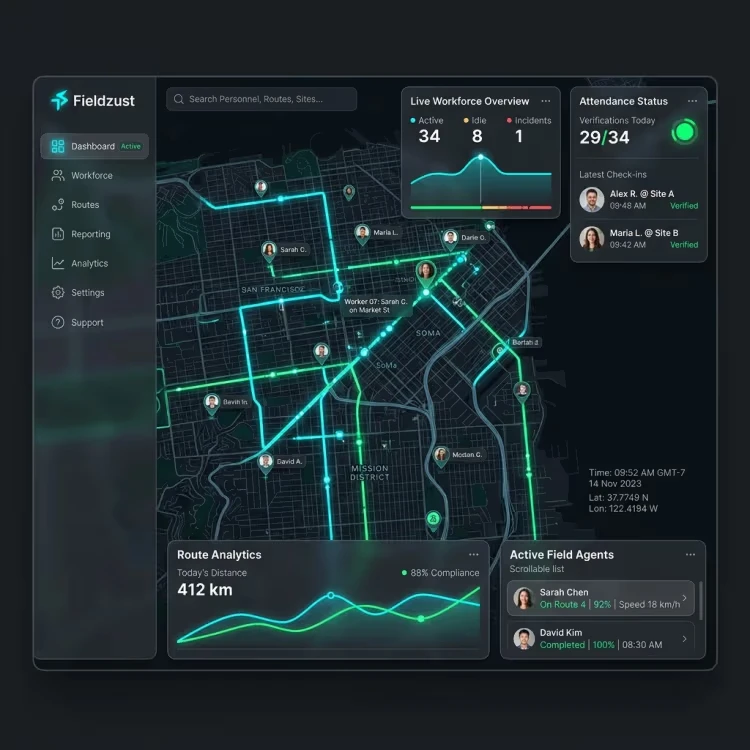
Fieldzust set out to give managers complete, honest visibility into a distributed field team — where people are, whether they actually visited, and what got done. The market it competes with is a paper diary, a WhatsApp group and self-reported timesheets, so the product only wins if the data is trustworthy. We built a platform that tracks live location, verifies attendance against real coordinates, and turns a day of field activity into a decision-grade dashboard.
Fieldzust — Complete Visibility for the Field Force
Real-time field-force tracking & operations platform.

A React Native app streams GPS breadcrumbs and lifecycle events (check-in, task update, check-out) to a fleet of Go microservices that ingest, validate and fan out telemetry over websockets to the Next.js console. Location and geofence geometry live in PostgreSQL with the PostGIS extension for spatial queries; Redis holds the hot presence layer (who is on-duty right now) and rate-limits noisy devices. Route history is compacted server-side so a full day replays smoothly without shipping thousands of raw points to the browser.
The hard problem was trust under bad conditions. Field phones drop signal, spoof GPS, and background-throttle location. A naive tracker records a straight line through buildings, accepts a check-in from a faked coordinate, and drains the battery. We had to make attendance provably real while surviving flaky mobile networks and OS power management.
- Anti-fraud guard rails: mock-location detection, accuracy-radius gating and server-side geofence verification reject "fake check-ins" before they reach attendance records.
- Adaptive breadcrumb sampling on-device — dense while moving, sparse while idle — with an offline queue that replays when signal returns, so routes stay accurate and battery survives a full shift.
- PostGIS geofences evaluate entry/exit server-side and fire instant alerts, decoupling the trigger from the phone that could be gamed.
- A streaming Go pipeline validates and deduplicates telemetry, keeping the live map at sub-second latency for hundreds of concurrent devices.